
.webp)
Landscape Lighting for Winter Garden & Horizon West Homes: Ideas & Installation Guide
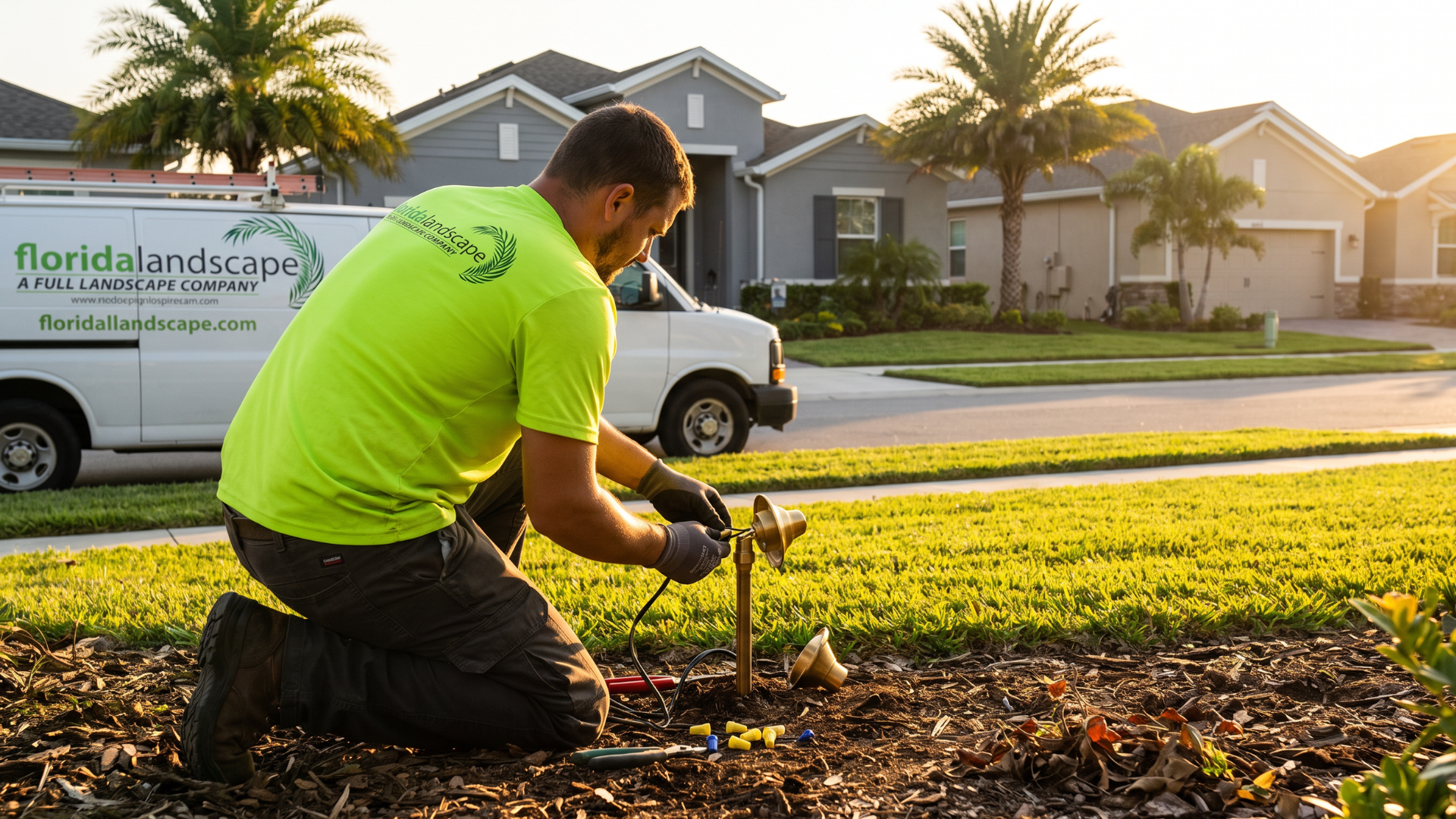
Landscape lighting in Winter Garden, FL is one of the fastest-growing outdoor improvement requests from homeowners — and for good reason. The communities around Winter Garden and Horizon West are newer, the homes are larger, and the HOA expectations for curb appeal are real. A well-designed lighting system doesn't just look good after dark; it adds depth to a flat lot, highlights plants and palms that took years to establish, and makes a property stand out in a neighborhood where every house was built from the same handful of models.
This guide covers what works specifically for newer Central Florida construction, how low-voltage LED systems are laid out, what you can expect to pay, and what to check with your HOA before a single fixture goes in the ground.
Why Landscape Lighting in Winter Garden and Horizon West Is Different
Newer construction in Winter Garden and Horizon West tends to share a common challenge: flat, uniform lots with matching floor plans up and down the street. The landscaping installed at builder closeout is typically minimal — a few palms, some shrubs along the foundation, and sod. That's a clean canvas, but it means there's not much natural variation to draw the eye.
Strategic lighting solves that. Uplighting adds vertical drama to palms. Pathway lights define the front walk and create visual layers. Downlighting from eaves casts shadows that make plantings look three-dimensional. Without thoughtful placement, even expensive fixtures produce flat, uninspiring results.
HOA communities in this area add another layer of planning. Many Horizon West and Winter Garden HOAs specify fixture finishes (usually bronze or black), restrict colored LEDs on street-facing surfaces, cap lumen output, or require that fixtures match a community standard established when the neighborhood was built. Check your covenants before purchasing anything — a fixture that violates HOA rules may need to come out entirely.
Fast growth in these communities also means neighbors are constantly upgrading. Homes that invest in lighting tend to influence the block — and raise the baseline expectation for what a well-kept property looks like.
Landscape Lighting Ideas That Work for Florida's Newer Homes
The most effective residential lighting designs layer multiple fixture types across zones. Here are the approaches that consistently work well on Central Florida lots:
Pathway lights along the front walk are almost always the first zone installed. They guide visitors, improve safety, and provide an immediate curb-appeal upgrade visible from the street. Low-voltage LED path lights on a 12V transformer outperform solar in this application — more on that comparison below.
Uplighting for palms and specimen plants is where Florida landscapes really come alive at night. A single well-placed flood or well light at the base of a queen palm creates a dramatic silhouette. Two or three coordinated fixtures uplighting a palm cluster or large oak become a focal point visible from the street and from inside the home.
Downlighting from eaves or soffit works especially well for covered patios and lanai areas. Fixtures mounted overhead cast a naturalistic glow downward — mimicking moonlight filtered through a canopy — and keep the patio functional for outdoor dining and entertaining after dark without harsh direct glare.
Entry pillar and driveway lighting adds a community-feel finish to a home's front elevation. Pillar-mounted fixtures or low bollards flanking a driveway entrance immediately upgrade perceived value, particularly on two-story homes where the garage occupies most of the front facade.
Color-changing LEDs for entertaining areas have become popular for pool decks and back patios. These are fine for private outdoor areas — but keep them out of the front yard if your HOA restricts colored lighting on street-facing surfaces. Warm white (2700K–3000K) is the safe, attractive default for most front-of-home applications.
What to avoid: Cheap solar path lights from big-box stores die within one Central Florida summer. The battery capacity drops fast in heat, and the light output becomes inconsistent within months. Avoid over-lighting that washes out an entire bed with flat brightness — the goal is contrast and depth, not stadium illumination. Also avoid mixing warm (2700K) and cool (5000K) color temperatures in the same zone; the difference is visible and looks unplanned.
Solar vs. Low-Voltage LED: Honest Comparison for Central Florida
The solar versus low-voltage debate comes up constantly. Solar fixtures cost less upfront and require no wiring — but they carry real limitations in Florida's climate and in shaded yards. Here's how the two options compare for a typical Winter Garden or Horizon West lot:
• Upfront cost — Solar Path Lights: Low ($20–$60/fixture) — Low-Voltage LED (12V): Higher ($40–$120+/fixture)
• Wiring required — Solar Path Lights: No — Low-Voltage LED (12V): Yes (transformer + wire runs)
• Performance in shade — Solar Path Lights: Poor — needs direct sun to charge — Low-Voltage LED (12V): Consistent regardless of sun
• Heat/humidity durability — Solar Path Lights: Battery degrades fast in FL heat — Low-Voltage LED (12V): Lasts 5–10+ years with quality fixtures
• Light output consistency — Solar Path Lights: Dims as battery ages — Low-Voltage LED (12V): Consistent, controllable
• Smart control / dimming — Solar Path Lights: None — Low-Voltage LED (12V): Yes — timer, dimmer, app control
• Long-term value — Solar Path Lights: Low — frequent replacement — Low-Voltage LED (12V): High — lower lifetime cost
For a front yard pathway on a well-lit, south-facing lot with no shade, solar can work short-term. For anything more than 6–8 basic path fixtures, or for any uplighting application, low-voltage LED on a hardwired transformer is the right system.
Tip: Look for fixtures that are ENERGY STAR certified for outdoor use. The ENERGY STAR certified outdoor fixture database lists products tested for efficiency and longevity — a useful starting point when comparing quality tiers.
How a Low-Voltage LED System Is Laid Out
Understanding the basics of a low-voltage system helps homeowners make informed decisions about scope and budget. Most residential installations use the same fundamental components:
1. Transformer: The transformer plugs into a standard exterior outlet and steps voltage down from 120V to 12V. Transformer size is rated in watts — a 150W unit runs roughly 15–20 standard fixtures; larger properties or more zones need a 300W or higher unit. Smart transformers allow scheduling, dimming, and zone control from a phone app.
2. Wire runs: Low-voltage wire (typically 12 or 16 gauge) runs from the transformer to each fixture zone. Wire can be surface-run and covered with mulch, or trenched just below grade for a cleaner look. Longer runs require heavier gauge wire to prevent voltage drop, which dims fixtures at the far end of a run.
3. Fixture types: Spike-mount path lights insert directly into soil for walkways and beds. Flood lights on adjustable stakes direct a beam upward for uplighting trees and palms. Well lights are flush-mounted in the ground and are ideal for accent lighting at the base of pillars or specimen plants. Each type serves a specific purpose — mixing them intentionally is what creates depth.
4. Zone layout: A standard residential lot in Winter Garden or Horizon West typically uses 2–4 zones: front pathway, front uplighting, back patio or pool area, and sometimes a side-yard or driveway zone. Zones can be controlled independently — turning off uplighting at midnight while leaving path lights on until dawn, for example.
If you're considering adding or upgrading a system, our landscape lighting installation service handles design, wiring, fixture selection, and transformer programming — with follow-up adjustments once everything is installed and you can see it after dark.
Landscape Lighting Cost in Winter Garden and Horizon West
Installation pricing varies based on fixture count, fixture quality, number of zones, transformer size, and whether wire runs are trenched or surface-laid. Here are realistic cost ranges for the Winter Garden and Horizon West market:
• Basic front pathway install — Fixture Count: 8–12 path fixtures — Estimated Cost: $800–$1,500
• Full front-yard design & install — Fixture Count: 15–30 mixed fixtures — Estimated Cost: $2,000–$5,000+
• Back patio / entertaining space — Fixture Count: 10–20 fixtures — Estimated Cost: $1,500–$4,000
• Whole-property package — Fixture Count: 30–50+ fixtures — Estimated Cost: $5,000–$10,000+
Fixture quality is one of the biggest cost drivers. Cast brass and copper fixtures cost more upfront but outlast cheap aluminum alternatives by years in Florida's humidity and salt-air proximity. Transformer size and smart control features add to the base price but reduce long-term operating costs.
Trenching wire adds labor time but produces a cleaner installation with less risk of damage from yard equipment. On newly sodded or freshly landscaped properties — common in Horizon West new construction — trenching is usually the better long-term choice.
For a more detailed breakdown of what landscape lighting costs across Central Florida, see our landscape lighting cost guide.
Note: These estimates reflect professional installation with quality fixtures. DIY kits from home improvement stores may appear cheaper upfront but typically require replacement within 2–3 years in Florida conditions.
HOA Considerations Before You Install
Horizon West and Winter Garden are both heavily HOA-governed markets. Before any fixtures go in, review your community's covenants, conditions, and restrictions (CC&Rs) for language about exterior lighting. Common HOA restrictions include:
Fixture finish requirements: Many communities specify bronze or black fixtures only — no chrome, no white, no mismatched finishes visible from the street.
Color restrictions: Some HOAs prohibit colored LEDs (red, blue, green) on street-facing elevations. Color-changing fixtures for the back patio are typically fine — but confirm before purchasing.
Lumen caps: Certain communities set maximum lumen output for residential fixtures to prevent light trespass onto neighboring properties. The International Dark-Sky Association also provides guidance on responsible outdoor lighting practices that align with most HOA expectations and reduce light pollution in residential communities.
Approval processes: Some HOAs require an architectural review committee (ARC) submission before exterior modifications — including lighting — are approved. This can take 2–4 weeks, so factor that into your project timeline.
If you manage or live in an HOA community in Winter Garden or Horizon West, our team is experienced with local HOA requirements. See our Horizon West landscaping service page for details on how we work within community guidelines, or explore our Winter Garden location page for service availability in your area.
For properties that need a broader outdoor upgrade alongside lighting — new beds, fresh mulch, or a design refresh — our landscape design and installation service can coordinate both scopes so the lighting complements whatever plantings go in at the same time.
Ready to Add Landscape Lighting to Your Winter Garden or Horizon West Home?
The right lighting system makes a real difference in how a home looks and functions after dark — and in HOA communities where curb appeal matters, it's one of the most visible improvements you can make. Florida Landscape Co. has been designing and installing low-voltage LED systems for Central Florida homeowners since 2011, with licensed installers who know the local conditions, the HOA landscape, and what actually holds up in the heat and humidity.
We serve Winter Garden, Horizon West, and surrounding communities including Clermont, Davenport, and Four Corners. Every lighting project starts with a design consultation so we can see the property, understand your goals, and recommend a system that fits the space and your budget.
Call us at (863) 582-2168 or visit our contact page to schedule a landscape lighting design consultation — we'll come out, walk the property, and give you a clear quote before any work begins.
Frequently Asked Questions
How many landscape lighting fixtures do I need for a typical Winter Garden home?
Most standard residential lots in Winter Garden and Horizon West start with 10–20 fixtures for a front-yard design that includes pathway lights and uplighting. Full-property installs covering front yard, back patio, and side areas often run 30–50+ fixtures across multiple zones. A site visit is the best way to get an accurate fixture count for your specific lot.
Are solar landscape lights worth it in Central Florida?
Solar path lights work short-term in fully sunny locations, but battery performance degrades quickly in Florida's heat. Most homeowners find they're replacing cheap solar fixtures every 1–2 years. For consistent, long-term performance — especially for uplighting or any shaded area — low-voltage LED on a hardwired transformer is the better investment.
Will my HOA approve landscape lighting in Horizon West?
Most Horizon West HOAs permit landscape lighting but regulate fixture color, finish, and sometimes lumen output. Some require an ARC (architectural review committee) approval before installation. Review your CC&Rs first and submit for approval if required — a professional installer familiar with local HOA standards can help you select compliant fixtures from the start.
How long does landscape lighting installation take?
A front-yard pathway and uplighting install on a standard residential lot typically takes one full day. Larger whole-property projects with multiple zones and trenched wire runs may take two days. Smart transformer programming and final fixture adjustments are done at the end of the install once everything is powered and visible after dark.
What color temperature should I use for landscape lighting in Florida?
Warm white in the 2700K–3000K range is the standard recommendation for most residential landscape lighting. It reads as welcoming and natural, pairs well with Florida's green foliage and earth-tone home exteriors, and complies with most HOA restrictions that prohibit colored LEDs on street-facing areas. Avoid mixing warm and cool color temperatures in the same visible zone.
Does landscape lighting add value to a home in Winter Garden?
Yes — curb appeal improvements including landscape lighting consistently contribute to perceived home value, particularly in competitive HOA communities where exterior presentation matters. A well-designed low-voltage LED system is also a selling point for buyers who want move-in-ready outdoor living spaces, which are in high demand in the Winter Garden and Horizon West market.

Get your free quote and expert advice today.
Ready to transform your garden? Get in touch with our expert team today for a free consultation and personalized plan.



Landscape Lighting in Winter Garden & Horizon West: Frequently Asked Questions
How many landscape lighting fixtures do I need for a typical Winter Garden home?

Most standard residential lots in Winter Garden and Horizon West start with 10–20 fixtures for a front-yard design that includes pathway lights and uplighting. Full-property installs covering front yard, back patio, and side areas often run 30–50+ fixtures across multiple zones. A site visit is the best way to get an accurate fixture count for your specific lot.
Are solar landscape lights worth it in Central Florida?
Solar path lights work short-term in fully sunny locations, but battery performance degrades quickly in Florida's heat. Most homeowners find they're replacing cheap solar fixtures every 1–2 years. For consistent, long-term performance — especially for uplighting or any shaded area — low-voltage LED on a hardwired transformer is the better investment.
Will my HOA approve landscape lighting in Horizon West?
Most Horizon West HOAs permit landscape lighting but regulate fixture color, finish, and sometimes lumen output. Some require an ARC (architectural review committee) approval before installation. Review your CC&Rs first and submit for approval if required — a professional installer familiar with local HOA standards can help you select compliant fixtures from the start.
How long does landscape lighting installation take?
A front-yard pathway and uplighting install on a standard residential lot typically takes one full day. Larger whole-property projects with multiple zones and trenched wire runs may take two days. Smart transformer programming and final fixture adjustments are done at the end of the install once everything is powered and visible after dark.
What color temperature should I use for landscape lighting in Florida?
Warm white in the 2700K–3000K range is the standard recommendation for most residential landscape lighting. It reads as welcoming and natural, pairs well with Florida's green foliage and earth-tone home exteriors, and complies with most HOA restrictions that prohibit colored LEDs on street-facing areas. Avoid mixing warm and cool color temperatures in the same visible zone.

