.webp)
Irrigation System Installation vs. Repair: A Central Florida Homeowner's Guide
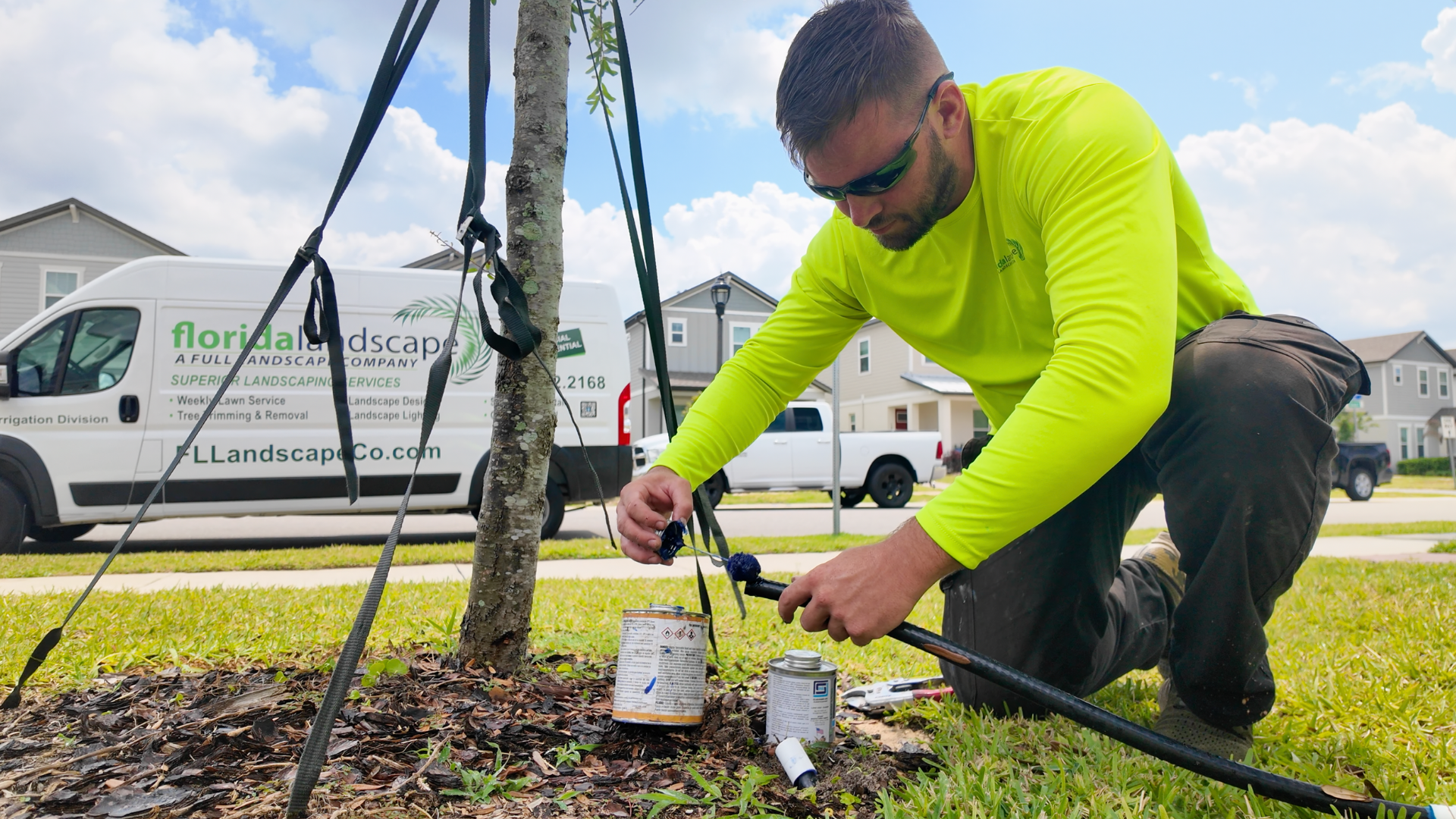
Irrigation system installation in Central Florida is one of the most consequential investments a homeowner can make for their lawn — and knowing whether to repair what you have or start fresh can save you thousands of dollars over time.
The trouble is, most homeowners don't know where that line is. A single broken head is an easy call. But what about a system that's thrown three valve failures in one season, leaks in two different spots, and runs on a controller that's older than your roof? That's where the math gets real.
This guide is built for exactly that moment — when you've got an irrigation problem and you're trying to figure out whether fixing it is worth it, or whether a full replacement will actually cost less in the long run.
Signs Your System Is Past the Repair Threshold
Not every irrigation problem is a sign of system failure, but some patterns make it clear that repairs are becoming a losing game. The clearest signal is repeated valve failures. If you've had two or more valves fail in a single year, the solenoids and diaphragms throughout the rest of the system are likely at the same age and condition — meaning more failures are coming.
Old PVC pipe with multiple leak points is another red flag. In Central Florida, soil movement, tree roots, and decades of heat cycling cause brittle PVC to crack in multiple places. When you're repairing the same line segment in different spots, you're not fixing a problem — you're chasing one.
Sprinkler heads installed before 2010 are worth scrutinizing too. Pre-WaterSense era heads operate at lower efficiency standards and are often mismatched with modern pressure expectations. Replacing them piecemeal rarely produces the uniform coverage a redesigned system would deliver.
Two issues that are immediate red flags in Florida specifically: no rain sensor and no smart controller capability. Florida law requires rain sensors on all new irrigation installations, and if your system is missing one, you're likely overwatering during rain events and paying for it. A controller with no Wi-Fi or scheduling flexibility makes it nearly impossible to comply with county watering restrictions — or to adjust for the dramatic swing between dry season and rainy season that Central Florida sees every year.
When Repair Is the Right Call
Repair makes clear financial sense in several scenarios. If the problem is isolated — one broken head, one zone that won't activate, one valve that's stuck — you're looking at a targeted fix rather than a systemic failure. Single-zone issues are common after landscaping work, mowing accidents, or freeze events, and they don't indicate anything wrong with the rest of the system.
If your system is under five years old, repair is almost always the right move. A well-installed system with quality components should last 15 to 20 years with proper maintenance. Problems in the early years are usually isolated rather than structural.
Pressure consistency matters too. If water pressure is stable throughout the system and the issue is confined to one area, you don't have a design or pipe problem — you have a component problem. That's fixable.
As a general rule: if the total repair cost stays under $300 and the problem is not part of a recurring pattern, repair wins. If you're stacking repairs across multiple zones and the bill is climbing toward $800 or more, the conversation about replacement becomes much more practical.
Tip: If you're unsure whether your system's issues are isolated or systemic, a professional irrigation audit can give you a clear picture before you spend money on either path. Our team at Florida Landscape Co. provides irrigation assessments across the Central Florida service area — reach out before committing to a repair that may not hold.
For common troubleshooting scenarios, our post on what to do when your sprinkler system isn't working in Central Florida covers zone-by-zone diagnostics that can help narrow down whether the problem is localized or widespread.
What a New Irrigation System Installation Involves
A full residential irrigation system installation in Central Florida typically runs between $2,500 and $6,000, depending on lot size, number of zones, and the components specified. That range reflects the difference between a basic system on a quarter-acre lot and a fully zoned, smart-controller-equipped setup on a half-acre or larger property.
Here's what the installation process actually includes:
1. System design and zone layout: A licensed contractor maps your property and divides it into zones based on plant type, sun exposure, and water demand. Turf zones and bed zones should never run together — they have different precipitation rate requirements.
2. Pipe and head installation: PVC or poly pipe is trenched in, and heads are positioned for proper head-to-head coverage. Rotor heads, spray heads, and micro-drip emitters are selected based on the zone.
3. Controller installation: A programmable controller (ideally Wi-Fi enabled or ET-based) is installed and programmed to the county's watering schedule. In Polk and Lake counties, residential irrigation is limited to two days per week under Water Management District rules.
4. Backflow preventer: Required by Florida plumbing code for all new irrigation connections to a potable water supply. This is not optional, and any contractor who skips it is cutting a corner that could create a code violation and a health risk.
5. Rain sensor: Also required by Florida law on all new installations. Rain sensors shut the system off during and after rainfall events, preventing overwatering and keeping you in compliance.
6. Permitting: Some counties in Central Florida require a permit for irrigation installation. Your contractor should know the local requirements and pull the permit where needed. If a contractor tells you permits aren't necessary without checking, that's a warning sign.
Our irrigation installation and repair services cover all of these components for residential and commercial properties across the Central Florida area. We design for Florida conditions — sandy soil, high summer rainfall, and dry-season stress — not a generic template.
Repair vs. New Installation: A Side-by-Side Comparison
• Best for — Repair: Isolated failures, systems under 5 years old — New Installation: Aging systems, recurring failures, no rain sensor
• Typical cost — Repair: $75–$400 per visit — New Installation: $2,500–$6,000 residential
• System lifespan impact — Repair: Extends current system life if problem is isolated — New Installation: Resets lifespan to 15–20 years
• Water efficiency — Repair: Depends on existing head/controller quality — New Installation: High — modern heads, smart controller, rain sensor
• Code compliance — Repair: May remain non-compliant (no rain sensor, old heads) — New Installation: Fully compliant with FL law and county restrictions
• Smart controller option — Repair: Add-on if wiring supports it — New Installation: Included in full design
• Permit required — Repair: Usually not for minor repairs — New Installation: Often yes — county dependent
• Risk — Repair: Ongoing repairs if systemic issues exist — New Installation: Higher upfront cost
Smart Controllers and Water Savings in Central Florida
One of the strongest arguments for a new irrigation system installation in Central Florida is the water savings a modern smart controller delivers. ET-based controllers (evapotranspiration) use local weather data — temperature, humidity, wind, and solar radiation — to calculate exactly how much water your lawn needs each day and adjust run times automatically. Soil moisture sensors take it a step further by measuring actual moisture levels in the root zone before running a cycle.
The result is meaningful. Studies from the Southwest Florida Water Management District show that smart irrigation controllers can reduce outdoor water use by 20 to 40 percent compared to timer-only systems. In a region where outdoor irrigation accounts for the majority of residential water use, that's a real number on your monthly utility bill.
The Southwest Florida Water Management District also offers rebates to homeowners who upgrade to qualifying smart controllers. If your property falls within the SWFWMD service area — which covers much of the Central Florida region — you may be able to offset part of the upgrade cost through their rebate program. Check the district's current rebate offerings before purchasing a controller, as amounts and qualifying models change periodically.
Staying on a proper irrigation schedule also directly affects lawn health. Our Florida lawn care calendar covers the seasonal shifts between dry-season irrigation demand and rainy-season runoff risk — a cycle that a smart controller manages automatically, and that a fixed timer handles poorly.
Consistent, calibrated irrigation is also the foundation of a healthy maintenance program. Our lawn and landscape maintenance services work best when the irrigation system underneath is doing its job correctly — under or overwatering forces corrections at the turf level that could have been avoided.
Questions to Ask Before Hiring an Irrigation Contractor
In Florida, irrigation contractors are required to hold a state license. This is not optional — performing irrigation work without the appropriate license is a violation of Florida law, and unlicensed work creates liability for the homeowner if something goes wrong with the water supply connection or fails inspection. You can verify a contractor's license status through the Florida Department of Agriculture and Consumer Services or the Florida Department of Business and Professional Regulation.
Ask these questions before signing anything:
1. Are you a licensed irrigation contractor in Florida? Get the license number and verify it. This is non-negotiable.
2. Will you pull a permit if the county requires one? A contractor who skips permitting to save time is passing the risk to you. Unpermitted work can complicate home sales and insurance claims.
3. What's the warranty on parts and labor? Quality contractors stand behind their work. Ask specifically — a parts warranty from the manufacturer and a separate labor warranty from the contractor are both standard on a full installation.
4. Will you install a backflow preventer and rain sensor? If the answer is no or "only if you want one," walk away. Both are required on new installations in Florida.
5. How do you design zone layout? A well-designed system separates turf from beds, accounts for shade and sun differences, and matches head type to precipitation rate. If the answer is vague, the design probably is too.
Note: Florida Landscape Co. is a licensed, insured irrigation contractor serving Clermont, Davenport, Haines City, Four Corners, Horizon West, Winter Garden, Kissimmee, and surrounding areas. We pull permits where required and back all installations with a labor and parts warranty.
Schedule an Irrigation Assessment with Florida Landscape Co.
If your system is throwing repeated problems and you're not sure whether it's worth fixing, the most useful thing you can do is get a professional assessment before spending another dollar on repairs. We'll evaluate your current system, identify whether the issues are isolated or systemic, and give you a straight answer on whether repair or replacement makes more financial sense for your property.
Florida Landscape Co. has been serving Central Florida homeowners since 2011. We understand the soil, the seasonal water cycles, and the county-specific rules that affect how irrigation systems should be designed and maintained here.
Call us at (863) 582-2168 or contact us online to schedule your irrigation assessment. We serve Clermont, Davenport, Haines City, Four Corners, Horizon West, Winter Garden, Celebration, Kissimmee, and the surrounding Central Florida area.
Frequently Asked Questions
How much does irrigation system installation cost in Central Florida?
Most residential irrigation system installations in Central Florida range from $2,500 to $6,000. The cost depends on lot size, number of zones, head types, and whether a smart controller is included. Larger properties or those requiring extensive trenching will be at the higher end of that range.
Does Florida law require a rain sensor on irrigation systems?
Yes. Florida law requires a functioning rain sensor or other automatic shutoff device on all new irrigation systems connected to a potable water supply. Any licensed contractor installing a new system must include one. Existing systems are strongly encouraged to add one if they don't already have it.
How many days per week can I water my lawn in Polk or Lake County?
Residential irrigation in Polk and Lake counties is generally restricted to two days per week under Southwest Florida Water Management District rules. The specific days allowed depend on your address. Year-round restrictions apply, with additional limits sometimes imposed during drought conditions. Check with your water utility or the SWFWMD for your specific schedule.
Is it worth repairing an old sprinkler system or should I replace it?
If your system has had two or more valve failures in a year, has multiple pipe leak points, lacks a rain sensor, or is running on a non-programmable controller, replacement is likely the better financial decision over the long term. If the issue is a single broken head or zone, repair usually makes more sense — especially if the system is under five years old.
Do I need a permit to install an irrigation system in Central Florida?
Permit requirements vary by county. Some Central Florida counties require a permit for new irrigation installations, particularly when a connection to the potable water supply is involved. A licensed irrigation contractor will know the requirements for your jurisdiction and should pull the permit where needed as part of the installation process.
Can a smart irrigation controller really lower my water bill?
Yes, in most cases significantly. ET-based and soil moisture smart controllers reduce water use by 20 to 40 percent compared to fixed-timer systems by adjusting run times based on actual weather and soil conditions. The Southwest Florida Water Management District also offers rebates on qualifying smart controllers, which can offset part of the upgrade cost.

Get your free quote and expert advice today.
Ready to transform your garden? Get in touch with our expert team today for a free consultation and personalized plan.