.webp)
How to Choose a Landscaping Company for Your HOA in Central Florida
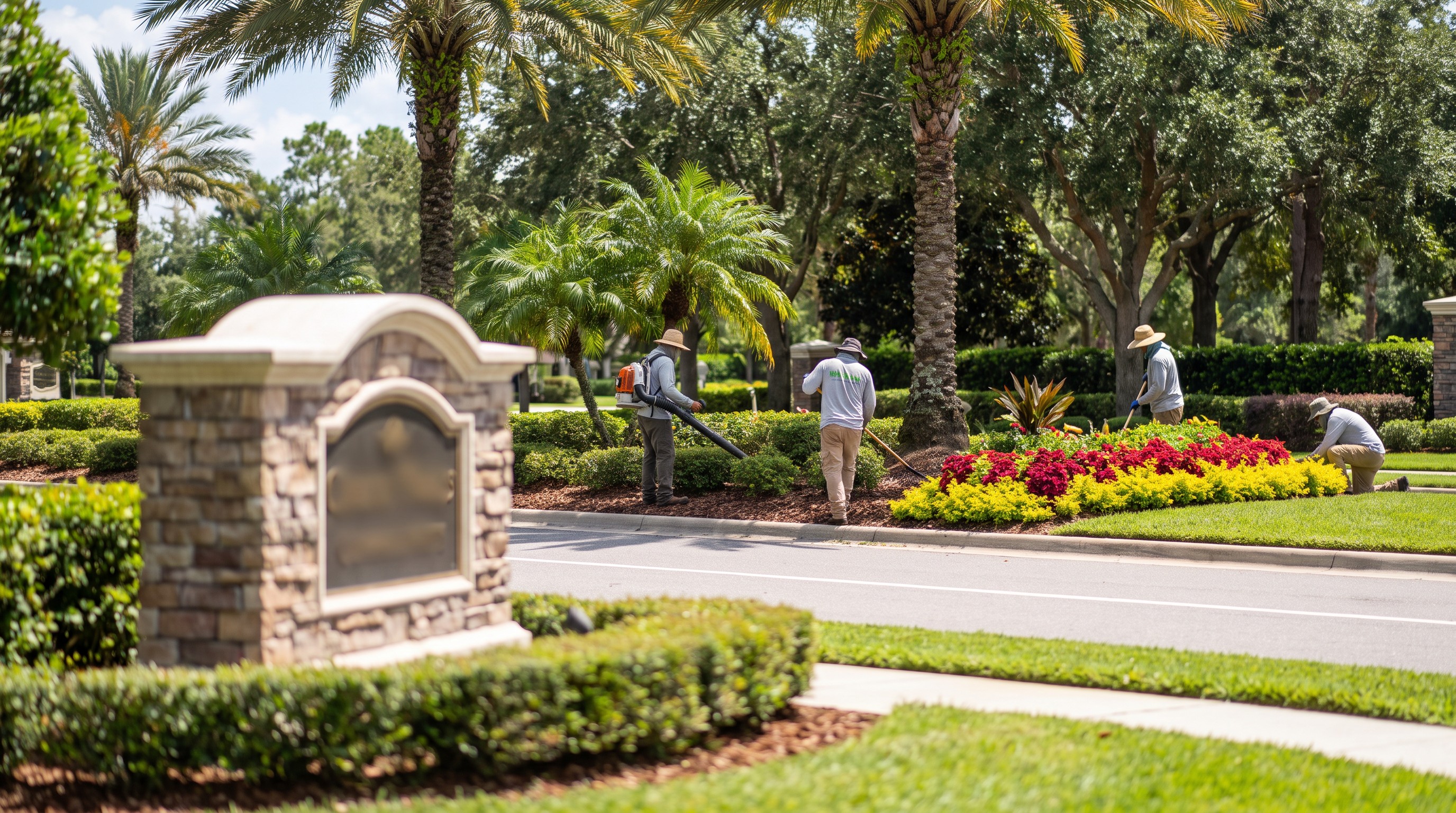
How to choose a landscaping company for your HOA is one of the highest-stakes decisions a board or property manager will make all year. Landscaping is the single largest recurring line item in most Central Florida HOA budgets, and it is the first thing residents, prospective buyers, and municipal inspectors see when they drive through the entrance. Get the vendor wrong and you inherit compliance violations, inconsistent common areas, and a mailbox full of resident complaints. Get it right and the decision practically runs itself for years.
This guide breaks down exactly what to evaluate, what questions to ask, and how Central Florida communities specifically — including deed-restricted neighborhoods in Horizon West, Davenport, and ChampionsGate — should approach landscaper selection differently than a homeowner picking a mow-and-blow crew.
Verify Licensing and Insurance Requirements
Start with the non-negotiables. Every landscaping company serving an HOA must carry proper licensing and comprehensive insurance coverage, because the board is contractually liable if a vendor's crew injures someone or damages property on association land.
Check for a valid Florida contractor license through the Department of Business and Professional Regulation. Commercial and common-area landscaping work often requires classifications beyond basic residential lawn maintenance permits, and a company that only holds a residential license may not be equipped to handle irrigation backflow work, tree removal near amenity structures, or large-scale turf renovation.
Insurance requirements should include general liability coverage of at least $1 million per occurrence, workers' compensation for all employees, and commercial auto insurance for company vehicles. Request current certificates of insurance and verify coverage directly with the carrier rather than trusting a PDF the vendor emails over — expired policies are more common than boards expect.
Evaluate HOA-Specific Experience and References
HOA landscaping is not the same job as residential lawn care performed at scale. Community associations require vendors who understand board governance, annual budget cycles, resident communication expectations, and the reality that every decision gets reviewed by a volunteer board that meets once a month.
Ask for references from at least three current HOA clients, ideally communities of similar size, unit count, and amenity complexity to your own. Contact these references directly and ask specific questions about communication responsiveness, how the vendor handles service complaints, and whether invoices matched the original proposal.
Review the company's portfolio of HOA work with a focus on entry signage beds, common-area turf, and community-wide seasonal color rotations. A contractor who can show consistent, photographed results across an entire community — not just a single well-maintained front yard — is the one built for association work. Our HOA and commercial landscaping services are built specifically around this kind of community-wide consistency and board-ready reporting.
Understand Central Florida Compliance Standards by Community
Deed restrictions and design guidelines vary sharply across Central Florida's fastest-growing HOA corridors, and a landscaper unfamiliar with these differences will create violations before they've even finished their first mow cycle.
Horizon West communities under Orange County's Horizon West Village Special Area Plan typically enforce strict entry feature and buffer landscaping standards tied to the original developer agreements — plant palettes, hedge heights along collector roads, and irrigation timing near shared amenity centers are often spelled out in detail. Davenport and Four Corners associations in Polk County frequently sit closer to conservation easements and retention ponds, which means your landscaper needs to understand setback rules around wetlands and stormwater buffers before they touch a mower near those zones. ChampionsGate communities, many still finishing build-out, often carry builder-imposed landscape standards during the transition period that differ from the association's long-term design guidelines — a vendor who doesn't ask which rule set currently applies will guess wrong.
Ask any prospective vendor directly: do they currently service a community in your specific municipality, and can they name the design review authority that governs your landscaping decisions? A vague answer here is the clearest early warning sign.
Assess Local Climate Knowledge and Plant Selection
Central Florida's growing conditions demand knowledge that a company transplanted from another region simply will not have. The right contractor understands sandy soils, intense summer heat, near-daily afternoon storms, hurricane preparation, and a growing season that essentially never stops.
Evaluate their familiarity with Florida-friendly plant species, correct irrigation timing under current water management district restrictions, and storm recovery procedures. Companies with genuine local experience recommend plant selections that reduce long-term maintenance costs instead of species that look good on installation day and die by August.
Tip: Ask specific questions about summer drought stress response, seasonal irrigation controller adjustments, and hurricane cleanup turnaround time. Generic or rehearsed answers usually mean limited hands-on Florida experience.
The University of Florida IFAS Extension maintains detailed Florida-Friendly Landscaping guidelines that many Central Florida HOA architectural committees now reference directly in their design standards — a qualified vendor should already be familiar with these principles.
Review Contract Terms and Service Specifications
Clear contract language protects the board and prevents the kind of scope disputes that eat entire board meetings. Review service specifications carefully to confirm they match your community's architectural guidelines, not a generic template the company uses for every client.
Look for detailed scope descriptions covering mowing frequency, trimming schedules, irrigation maintenance responsibilities, seasonal color rotation counts, and storm cleanup response times. Vague language like "routine maintenance as needed" gives the vendor room to under-deliver without technically violating the agreement.
Before signing anything, read our full breakdown of HOA landscaping contract red flags — it covers the specific clauses that have caused disputes for Central Florida boards, including auto-renewal terms, unclear storm-cleanup billing, and vague "seasonal color" allowances that let vendors substitute cheaper plants.
Understand Budget and Pricing Structures
Price comparisons between HOA landscaping proposals rarely compare apples to apples. One bid might exclude irrigation repairs and mulch refreshes that another bundles into the base contract, making a "cheaper" proposal significantly more expensive by year-end.
Ask for an itemized breakdown separating base maintenance, seasonal enhancements, irrigation service, and tree work. Boards that skip this step often approve a budget in January only to face surprise change orders by June.
For a full walkthrough of how to structure a realistic annual landscaping budget — including how much to reserve for storm cleanup and irrigation repairs — see our companion guide on HOA landscaping budgets, or ask any prospective vendor to walk your board through a sample year-one cost breakdown before you sign.
Printable HOA Landscaping Company Selection Checklist
Print this section and bring it to your next board meeting or vendor interview.
• Current Florida contractor license verified through DBPR
• General liability insurance of at least $1 million per occurrence confirmed directly with carrier
• Workers' compensation and commercial auto coverage documented
• Minimum three current HOA references contacted and checked
• Portfolio includes community-wide common area work, not just single-property photos
• Vendor can name your community's design review authority and applicable landscape standards
• Vendor demonstrates Florida-Friendly plant knowledge and irrigation timing compliance
• Written scope of work includes mowing frequency, trimming schedule, and seasonal color count
• Storm cleanup response time is specified in writing, not verbally promised
• Itemized pricing separates base maintenance from irrigation, tree work, and enhancements
• Contract includes clear renewal terms and a defined cancellation process
• Vendor offers regular reporting or a point of contact for board communication
Common Mistakes HOA Boards Make When Selecting a Landscaper
1. Choosing the lowest bid without confirming scope parity — a cheaper base price often excludes services another vendor bundles in.
2. Skipping reference checks with comparable communities, relying instead on a single glowing testimonial.
3. Failing to confirm the vendor understands the specific municipal or developer-imposed design standards governing the community.
4. Signing contracts with vague scope language that leaves "as needed" services open to interpretation.
5. Not budgeting separately for storm cleanup and irrigation repairs, then treating the resulting change orders as vendor overcharging.
6. Overlooking communication structure — boards that don't establish a reporting cadence upfront end up managing landscaping issues reactively instead of proactively.
According to the Community Associations Institute, well-maintained common areas remain one of the strongest predictors of resale value and resident satisfaction in association-governed communities — which is exactly why this vendor decision deserves more scrutiny than boards typically give it.

Get your free quote and expert advice today.
Ready to transform your garden? Get in touch with our expert team today for a free consultation and personalized plan.



Frequently Asked Questions
What questions should I ask a landscaping company before hiring them for our HOA?

Ask about current Florida licensing, insurance limits, at least three comparable HOA references, familiarity with your community's specific design standards, storm cleanup response times, and how pricing is itemized between base maintenance and add-on services like irrigation and tree work.
How do I know if a landscaping company is HOA-approved for my community?
There is no statewide "HOA-approved" certification — approval comes from your own board and architectural review committee based on the vendor meeting your community's specific insurance, licensing, and design-guideline requirements. Always confirm the vendor has reviewed your governing documents before signing.
Should our HOA get multiple landscaping bids before choosing a vendor?
Yes. Most boards should collect at least three itemized proposals covering identical scope so pricing can be compared fairly rather than judged on a single bottom-line number that may exclude irrigation, storm cleanup, or seasonal color.
What insurance should an HOA landscaping company carry?
At minimum, general liability coverage of $1 million per occurrence, workers' compensation for all employees, and commercial auto insurance for company vehicles. Boards should verify these directly with the insurance carrier rather than relying solely on documents the vendor provides.
How often should our HOA re-bid its landscaping contract?
Most Central Florida associations re-bid every two to three years, or sooner if service quality declines, pricing increases significantly without justification, or the community's amenities and common areas expand. Building a re-bid clause into the original contract keeps this process predictable rather than contentious.

