.webp)
Commercial Sod Installation in Central Florida: A Guide for Property Managers
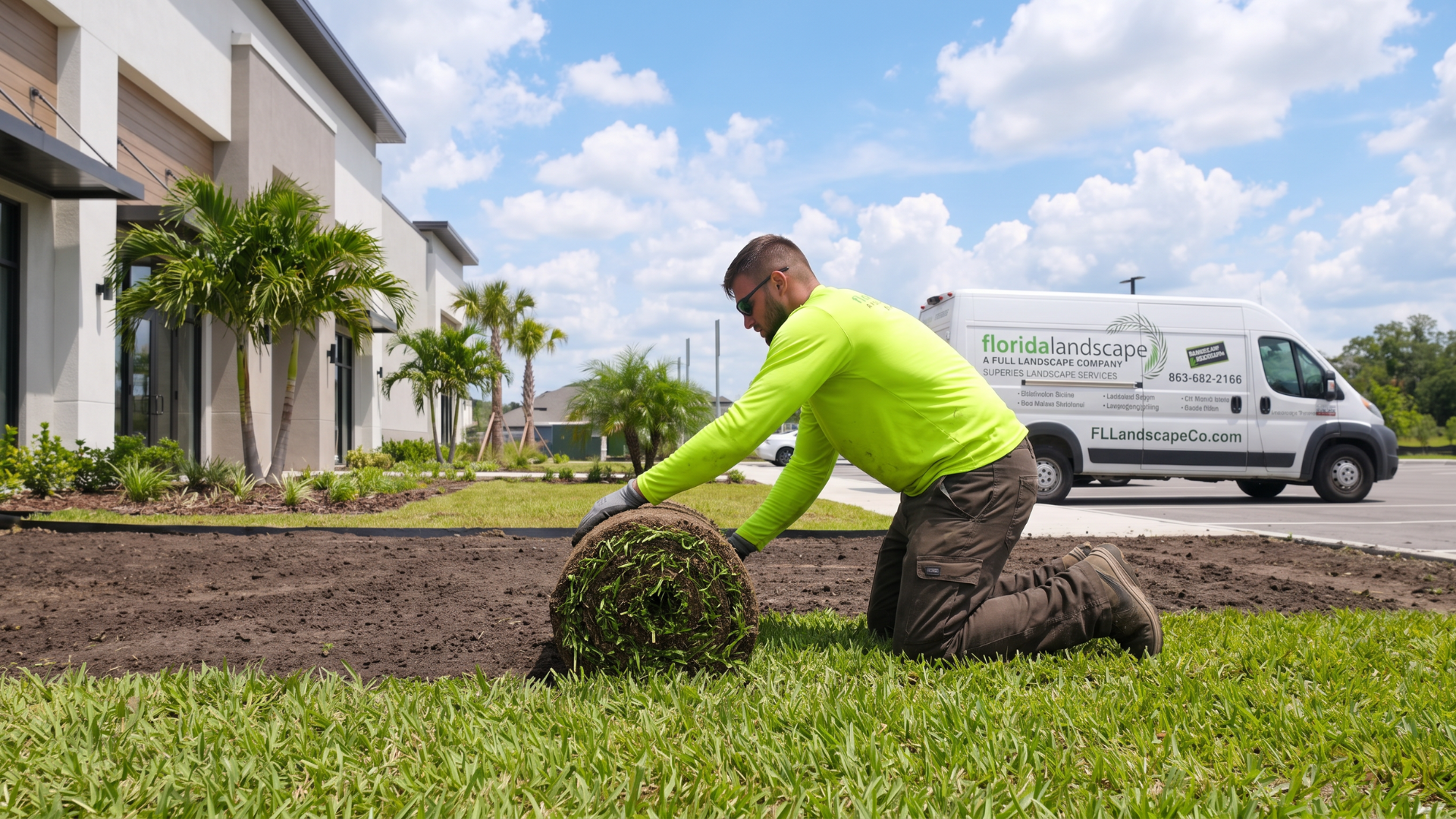
Commercial sod installation in Central Florida is a different animal than a residential job — the scale, coordination requirements, and margin for error are all amplified when you're covering thousands of square feet of common area, entry corridors, or commercial grounds.
Whether you're replacing worn-out turf after a dry season, refreshing an HOA entry feature, or completing a new construction handoff, this guide walks through what property managers and facility directors actually need to know before the first pallet hits the ground.
How Commercial Sod Projects Differ From Residential
A residential sod install might cover 4,000–8,000 square feet across a single home. A commercial project can run 15,000 to 80,000 square feet or more — spread across common areas, retention pond edges, parking lot islands, walking paths, and entry landscaping.
That scale changes everything: crew size, equipment access, pallet delivery logistics, and the irrigation system demands that must support establishment watering across dozens of zones simultaneously.
Note: Commercial irrigation systems typically require higher zone counts, greater head spacing, and more precise pressure regulation than residential setups. Before sod goes down, an irrigation audit is often necessary to confirm the system can actually sustain the watering schedule new sod requires.
HOA properties add another layer: covenants frequently specify approved turf species, and installing the wrong grass — even if it looks fine initially — can trigger a compliance violation during the next board audit. Turf selection has to match what's documented in your community's landscaping standards, not just what's available at the closest sod farm.
ADA compliance is another consideration that rarely comes up in residential work. If sod installation touches areas adjacent to walkways, ramps, or accessible parking routes, grade and surface transitions have to meet ADA pathway standards. That affects how site prep and grading are handled before install.
Budget approval timelines are also longer on the commercial side. Most HOA boards and commercial property management companies require multiple vendor quotes, a line-item budget breakdown, and board or ownership approval before work can proceed. Building your project scope early — including irrigation modifications, debris removal, and post-install care — prevents budget surprises that can stall approval.
Our commercial landscaping services are structured to accommodate these planning timelines, including pre-project site assessments and written scope documentation for board or ownership review.
Turf Selection for Commercial Properties in Central Florida
Not every grass type is appropriate for high-visibility commercial settings. The wrong turf choice costs more to maintain and looks worse over time — especially under Florida's intense summer heat and heavy mowing schedules.
1. Floratam St. Augustine: The most commonly specified turf for HOA common areas and commercial entries in Central Florida. It produces a dense, uniform appearance that holds up well under commercial mowing equipment. It's shade-tolerant enough for areas with tree canopy and establishes quickly when irrigation is consistent. Most HOA covenants in this region default to Floratam as the standard turf type.
2. Empire Zoysia: A premium option for properties that want a lower-maintenance profile after establishment. Empire Zoysia grows slower than St. Augustine, which reduces mowing frequency — a real operating cost advantage on large properties. It handles moderate foot traffic well and provides a finer, more manicured look suited to upscale communities or corporate campuses.
3. Bermuda Grass: Best suited for athletic areas, high-traffic turf zones, retention pond edges, and play areas. Bermuda tolerates aggressive foot traffic and recovers quickly from damage. It's not a good fit for shaded areas and requires more frequent mowing to stay presentable, but for functional turf zones it outperforms both St. Augustine and Zoysia in durability.
Why Bahia usually isn't the right call for commercial: Bahia is a durable, low-input grass that performs well in residential settings with lower maintenance expectations. But for commercial and HOA properties where curb appeal matters, Bahia tends to look thin, uneven, and coarse — especially in high-visibility areas like entry features or building fronts. It's harder to maintain a uniform appearance, and its seedheads create an unkempt look that conflicts with HOA landscaping standards.
For a deeper look at how these grass types compare across Central Florida conditions, the UF IFAS Your Florida Lawn resource provides research-based guidance on turf selection for Florida's specific soil and climate conditions.
See also our full breakdown of Florida grass types for side-by-side comparisons of performance characteristics.
Commercial Sod Comparison: Turf Types at a Glance
• Floratam St. Augustine — Appearance: Dense, dark green, uniform — Maintenance Level: Moderate — Traffic Tolerance: Moderate — Best Commercial Use Case: HOA common areas, entries, building fronts
• Empire Zoysia — Appearance: Fine texture, manicured look — Maintenance Level: Low–Moderate — Traffic Tolerance: Moderate — Best Commercial Use Case: Upscale communities, corporate properties
• Bermuda — Appearance: Fine, tight, functional — Maintenance Level: Moderate–High — Traffic Tolerance: High — Best Commercial Use Case: Athletic areas, play zones, retention edges
• Bahia — Appearance: Coarse, uneven, seedheads visible — Maintenance Level: Low — Traffic Tolerance: High — Best Commercial Use Case: Low-visibility utility areas only
Timing Your Commercial Sod Installation in Central Florida
Florida's wet and dry season cycle has a direct impact on sod establishment success — and on your irrigation costs during the first 30–45 days after install.
The single best installation window in Central Florida is late September through November. The rainy season has just ended, temperatures are dropping into the low 80s and high 70s, and establishment watering demands are far more manageable than during peak summer. Sod roots in efficiently without fighting extreme heat stress.
February through March is the second-best window. Temperatures are still moderate, and sod installed before the summer heat arrives has enough time to root before stress conditions set in. Spring installs also benefit from the incoming rainy season to support late-stage establishment.
Important: Avoid scheduling large commercial installs in July and August if possible. Summer heat in Central Florida regularly exceeds 95°F with high humidity, and newly installed sod that isn't receiving perfectly consistent irrigation can go into heat stress within days. On a large commercial property with complex irrigation zones, maintaining perfect watering uniformity during that window is operationally difficult.
If a summer install is unavoidable — for instance, to meet a construction handoff deadline — plan for daily irrigation monitoring during the first two weeks and have a backup watering plan in place for irrigation system failures.
What Commercial Sod Installation Actually Costs
For commercial sod installation in Central Florida, expect a range of $1.75 to $3.25 per square foot installed, depending on site conditions, access constraints, and what's included in the scope.
Larger projects — typically 10,000 square feet and above — often qualify for volume pricing. A 25,000 square foot community entry and common area project will carry a lower per-square-foot cost than a 3,500 square foot retail landscape strip.
When building your budget for board or ownership approval, these are the line items that need to be accounted for separately:
1. Irrigation system audit and modifications: Before sod is installed, the existing irrigation system should be evaluated for zone coverage, head spacing, and pressure. Gaps in coverage lead to establishment failure in sections of the project — which means replacement cost. Budget for an audit and any valve, head, or zone modifications required.
2. Existing turf removal and disposal: If you're replacing old sod or weedy ground cover, removal and haul-off adds cost. On large commercial properties this can be significant — factor it as a separate line item, not an assumption.
3. Site prep and grading: Proper grading ensures drainage away from structures and prevents low spots that hold standing water. On commercial properties with ADA-adjacent areas, this step is especially important and should be documented.
4. Temporary erosion control: For larger sites or sloped areas near retention ponds, erosion control measures — silt fencing, straw covering — may be required during establishment. Some municipalities require this as part of the permitting process.
5. Post-install watering plan: New sod requires 2–3 waterings per day for the first 7–10 days, then tapering. On a large property, establishing who is responsible for monitoring this — and what the response plan is if irrigation fails — should be defined before installation begins, not after.
Our irrigation installation and repair services include pre-install system audits that can be scoped alongside your sod project to ensure coverage is ready before the first pallet arrives.
Managing a Large-Scale Commercial Sod Project
On occupied commercial properties and active HOA communities, phased installation often makes more operational sense than a single large-scale install. Breaking the project into zones — entry features first, then common areas, then secondary turf zones — reduces disruption to residents, employees, or customers and allows irrigation adjustments to be made between phases.
Coordination between the sod installation crew and the irrigation contractor is critical. Sod going down before irrigation heads are adjusted or new zones are activated is one of the most common avoidable failures on large projects. The sequence matters: irrigation verification before sod, not after.
Post-install care responsibility should be spelled out in the project contract. The question of who is monitoring establishment watering — the landscape contractor, the property manager, or the in-house maintenance staff — should be answered before the project starts. Missed watering in the first two weeks of a large commercial install can result in significant sod loss, and cost recovery disputes are far harder to resolve than a documented care plan established in advance.
The Southwest Florida Water Management District's irrigation guidelines include commercial property requirements for watering schedules and restrictions that apply during and after sod establishment — worth reviewing before your project goes to contract.
For HOA properties, our HOA landscaping services include documentation and reporting support for board communication — including installation records, turf species confirmation, and post-install care logs that can be retained for compliance purposes.
If your property is in or near Haines City, our Haines City service area covers commercial and HOA sod projects across the region with crews familiar with local soil conditions and water district requirements.
Ready to Get a Commercial Sod Quote?
Large sod projects have a lot of moving parts — turf selection, irrigation readiness, site prep, and post-install care all have to line up for the install to succeed long-term. Florida Landscape Co. has been managing commercial and HOA sod projects across Central Florida since 2011, and we understand what it takes to get these projects approved, installed, and established correctly.
We'll walk through your site, document what's needed for your board or ownership approval, and give you a clear, itemized quote — not a ballpark. Reach out to our team at (863) 582-2168 or request a commercial sod installation quote online to get started.
Frequently Asked Questions
What is the best grass for commercial sod installation in Central Florida?
Floratam St. Augustine is the most commonly used turf for HOA common areas and commercial properties in Central Florida. It provides a dense, uniform appearance and handles commercial mowing well. Empire Zoysia is a good option for properties prioritizing lower mowing frequency. Bermuda is better suited for high-traffic or athletic areas. Bahia is generally not recommended for high-visibility commercial settings.
How much does commercial sod installation cost in Central Florida?
Commercial sod installation in Central Florida typically runs $1.75 to $3.25 per square foot installed, depending on site conditions, access, whether existing turf needs to be removed, and what irrigation modifications are required. Large projects over 10,000 square feet often qualify for volume pricing. Always budget separately for irrigation audits, grading, debris removal, and post-install care.
When is the best time to install sod on a commercial property in Florida?
Late September through November is the ideal window — temperatures are dropping and the rainy season has just ended, making establishment watering more manageable. February through March is the second-best option. Avoid large commercial installs in July and August when possible, as extreme heat increases establishment risk, especially on properties with complex irrigation systems.
Does my HOA need a specific turf type for sod replacement?
Many HOA covenants in Central Florida specify approved turf species for common areas and residential lawns. Floratam St. Augustine is the most commonly listed. Before ordering sod for any HOA property, confirm the approved turf type with your governing documents or management company. Installing a non-approved variety can trigger a compliance issue even if the grass itself looks healthy.
Does the irrigation system need to be modified before commercial sod installation?
Usually, yes — at least an audit is necessary. New sod requires consistent, even coverage during the 30–45 day establishment period. Gaps in irrigation zone coverage, misaligned heads, or pressure issues that go undetected before install are a leading cause of sod loss on large commercial projects. An irrigation audit before installation is a standard part of responsible project scoping.
Can commercial sod be installed in phases on an occupied property?
Yes, and for large HOA communities or active commercial properties, phased installation is often the better approach. Installing by zone — entry features, then common areas, then secondary turf — reduces disruption and allows the contractor to confirm irrigation performance in completed zones before moving forward. It also makes budget approval easier when the full project is being funded across multiple fiscal periods.

Get your free quote and expert advice today.
Ready to transform your garden? Get in touch with our expert team today for a free consultation and personalized plan.



Commercial Sod Installation in Central Florida: Frequently Asked Questions
What is the best grass for commercial sod installation in Central Florida?

Floratam St. Augustine is the most commonly used turf for HOA common areas and commercial properties in Central Florida. It provides a dense, uniform appearance and handles commercial mowing well. Empire Zoysia is a good option for properties prioritizing lower mowing frequency. Bermuda is better suited for high-traffic or athletic areas. Bahia is generally not recommended for high-visibility commercial settings.
How much does commercial sod installation cost in Central Florida?
Commercial sod installation in Central Florida typically runs $1.75 to $3.25 per square foot installed, depending on site conditions, access, whether existing turf needs to be removed, and what irrigation modifications are required. Large projects over 10,000 square feet often qualify for volume pricing. Always budget separately for irrigation audits, grading, debris removal, and post-install care.
When is the best time to install sod on a commercial property in Florida?
Late September through November is the ideal window — temperatures are dropping and the rainy season has just ended, making establishment watering more manageable. February through March is the second-best option. Avoid large commercial installs in July and August when possible, as extreme heat increases establishment risk, especially on properties with complex irrigation systems.
Does my HOA need a specific turf type for sod replacement?
Many HOA covenants in Central Florida specify approved turf species for common areas and residential lawns. Floratam St. Augustine is the most commonly listed. Before ordering sod for any HOA property, confirm the approved turf type with your governing documents or management company. Installing a non-approved variety can trigger a compliance issue even if the grass itself looks healthy.
Does the irrigation system need to be modified before commercial sod installation?
Usually, yes — at least an audit is necessary. New sod requires consistent, even coverage during the 30–45 day establishment period. Gaps in irrigation zone coverage, misaligned heads, or pressure issues that go undetected before install are a leading cause of sod loss on large commercial projects. An irrigation audit before installation is a standard part of responsible project scoping.

