.webp)
Fall Lawn Care in Central Florida: What to Do in August, September & October
Florida lawn care fall is its own category — nothing like the dormancy-and-leaf-rake routines homeowners follow in the rest of the country. In Central Florida, grass stays actively growing through October, no frost arrives until December or January (if at all), and the single most important transition you'll manage is the shift from the summer rainy season into dry season. Get that window right and your turf heads into winter in strong shape. Get it wrong and you're playing catch-up from November through February.
This guide breaks down exactly what to do — and what to avoid — in August, September, and October across the most common grass types in the region: St. Augustine, Zoysia, and Bahia.
Why Central Florida's Fall Is Different From Everywhere Else
Most lawn care content written for fall assumes you're preparing for frost, dormancy, and cold-weather shutdowns. Central Florida doesn't work that way. August is still one of the hottest, wettest months of the year. September marks the tail end of the rainy season. October is when afternoon storms ease off, temperatures start to moderate, and the real work of transitioning into dry season begins.
The Osceola, Lake, and Polk County area — where Florida Landscape Co. operates — typically sees rainfall drop sharply in November. That means October is your last chance to set irrigation, soil health, and turf density before the long dry stretch begins.
Understanding this seasonal rhythm is the foundation of sound fall turf management. The Florida lawn care calendar looks completely different from anything written for a northern climate, and the decisions you make in late summer determine how well your lawn handles winter stress.
August: Manage the Peak of Rainy Season
August is still fully inside the summer rainy season, and it's also the period when fertilizer blackout rules are in effect across many Central Florida counties. Most local ordinances prohibit nitrogen fertilizer applications from June 1 through September 30. Do not fertilize in August — not even if the lawn looks pale or thin. Applying nitrogen during blackout period contributes to fertilizer runoff into local waterways and carries fines in many municipalities.
Important: Check your specific county's fertilizer ordinance. Lake, Osceola, and Polk counties each have their own rules. When in doubt, wait until October 1.
What you should be doing in August is scouting. Chinch bugs are at peak pressure during the hottest, driest pockets of summer, and even in a rainy season you'll find them hiding in stressed areas near driveways, curbs, and sandy high spots. Look for yellowing patches that don't green up after rain. Brown patch fungus is also common in August — it shows as roughly circular tan or brown patches with a darker ring at the edge, and it thrives when nighttime temperatures stay above 70°F with high humidity.
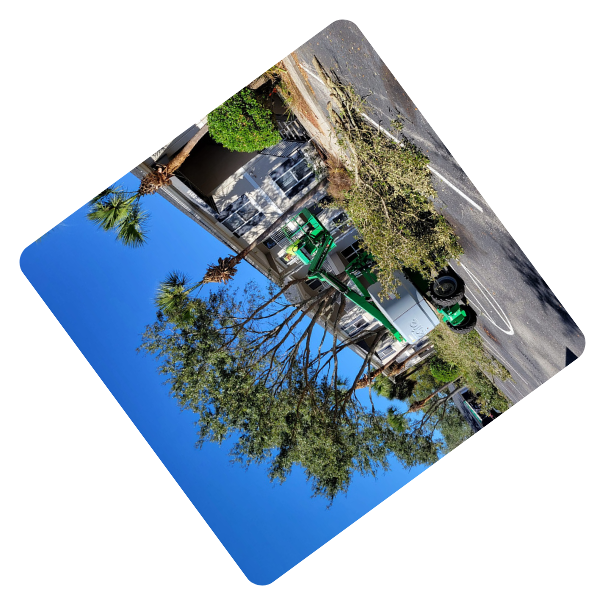
Continue watering deeply twice per week even if it's been raining. Afternoon thunderstorms are inconsistent — some areas of a yard get soaked while others stay dry. Keep your irrigation system running on its summer schedule and let the rain sensor do its job. Also review any storm damage from afternoon thunderstorms: broken limbs, leaning shrubs, or debris piled against turf can cause moisture retention and fungal problems.
Tip: If you have palm trees, only remove fronds that are fully brown and hanging below horizontal. Green fronds — even ones angled downward — are still feeding the trunk with stored nutrients. Cutting green fronds in late summer stresses palms heading into the cooler months.
September: Transition Month — Set Up for What's Coming
September is a bridge month. Rainfall is still frequent early in the month but begins tapering off by late September. Growth slows slightly — not dramatically, but enough that you may be able to reduce mowing frequency from weekly to every 10–14 days depending on grass type. Bahia in particular slows its seed head production as day length shortens.
The fertilizer blackout ends October 1, so September is the time to prepare. Test your soil if you haven't done so recently — UF IFAS Extension recommends soil testing every 1–2 years for Florida lawns. Knowing your pH and nutrient levels lets you pick the right fall product rather than guessing. You can find guidance on timing and product selection in the complete guide to fertilizing your lawn in Central Florida.
September is also the right time to aerate compacted areas — especially St. Augustine lawns with heavy foot traffic or clay-influenced soils. Core aeration opens up the root zone so the fall fertilizer application can actually reach where it needs to go. Aeration also improves drainage as the rainy season winds down.
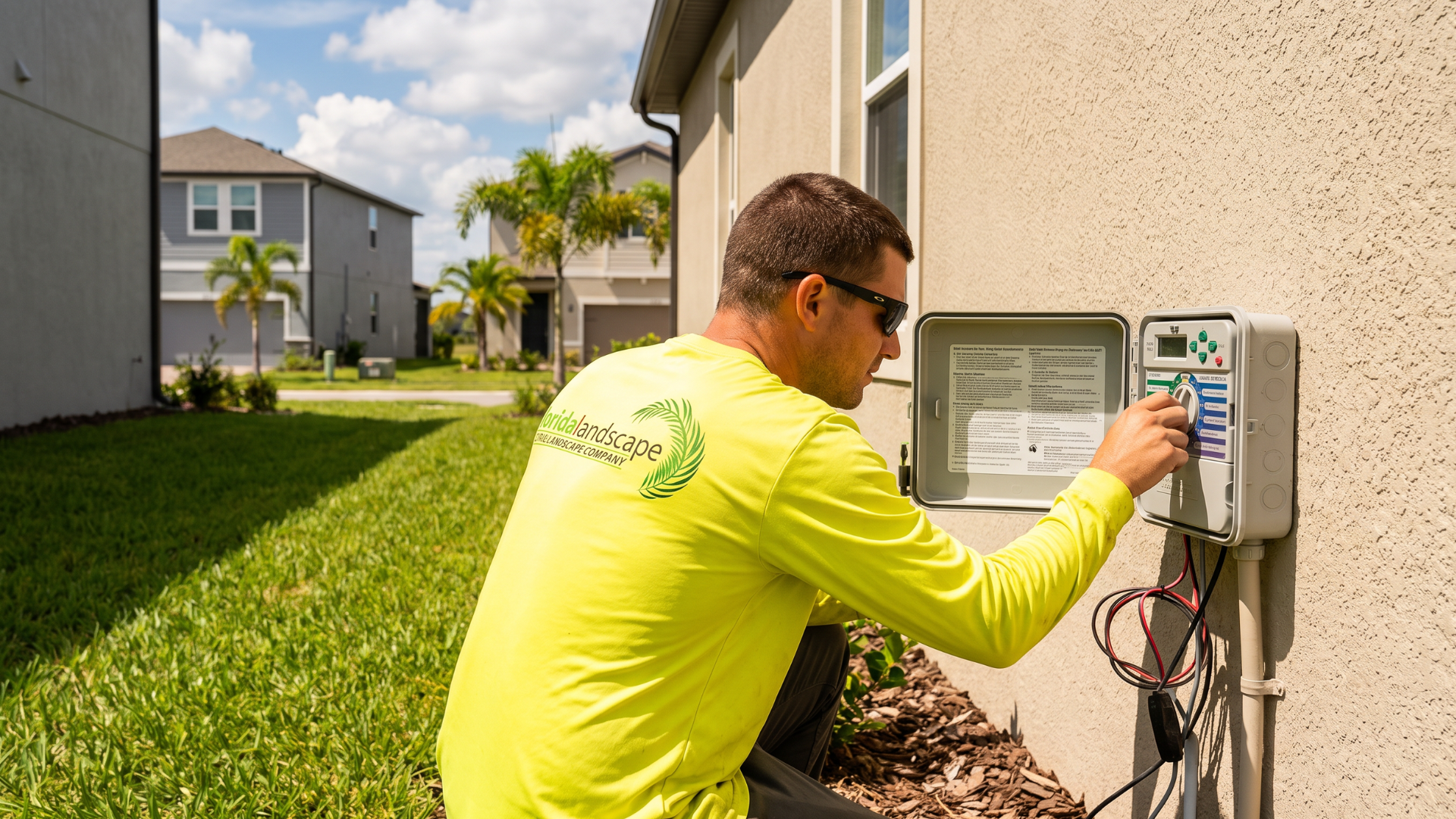
Start adjusting your irrigation controller in late September. You don't need to switch off — but you should begin transitioning from a full rainy-season schedule to a moderate transition schedule. Reduce run times slightly and monitor soil moisture manually a few times per week. The goal is to avoid both drought stress and the waterlogged conditions that promote fungal disease.
If your irrigation system has been running all summer without a professional check, September is a good time to schedule an audit. Our team at Florida Landscape Co. handles irrigation system inspections, repairs, and smart controller adjustments before dry season puts full demand on your zones.
October: Execute the Fall Lawn Care Plan
October is the most action-packed month of the Central Florida fall lawn care window. The blackout ends October 1, temperatures begin to ease, and the dry season is approaching fast. This is when you execute the tasks you've been preparing for.
Fertilize with a potassium-rich fall blend. Potassium (the K in N-P-K) strengthens cell walls, improves drought tolerance, and helps grass handle temperature fluctuations. A slow-release, lower-nitrogen formula with elevated potassium is the right fall choice for St. Augustine, Zoysia, and Bahia. Apply at label rates — don't over-apply thinking more is better.
Raise your mowing height slightly before November arrives. For St. Augustine, move from 3.5 inches to 4 inches. Taller turf shades the soil, retains more moisture, and provides a buffer if a cold snap does arrive in December or January. Do not scalp the lawn in fall — this is one of the most damaging mistakes Central Florida homeowners make. Short grass heading into dry season has less leaf surface for photosynthesis and less insulation for roots.
If you have a Bahia lawn and want winter green color, October is the window to overseed with annual ryegrass. Ryegrass germinates well in cooler soil temperatures and will provide color through the winter months before dying off naturally in spring when Bahia comes back strong.
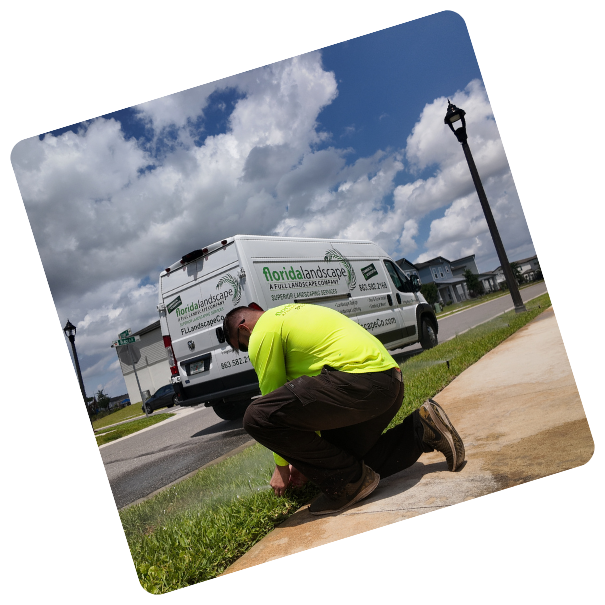
Run every irrigation zone manually and check each head for coverage, rotation, and output. Fix broken heads, clogged nozzles, or misaligned rotors before dry season begins. A single malfunctioning zone in November can cause significant turf damage before you notice it. Our year-round lawn and landscape maintenance plans include regular irrigation checks so nothing gets missed between seasons.
Month-by-Month Fall Lawn Care Task Table
• Fertilize lawn — August: No — blackout — September: No — blackout ends Oct 1 — October: Yes — potassium-rich blend — Notes: Follow county ordinance timing
• Mowing frequency — August: Weekly or as needed — September: Reduce to every 10–14 days — October: Raise height, reduce frequency — Notes: Never remove more than 1/3 of blade
• Irrigation schedule — August: Full summer schedule — September: Begin reducing run times — October: Transition to dry-season schedule — Notes: Check all zones manually in October
• Pest scouting — August: Chinch bugs, brown patch — September: Continue monitoring — October: Watch for armyworms — Notes: Act fast — damage spreads quickly
• Aeration — August: Not recommended — September: Good window for St. Augustine — October: Can continue if needed — Notes: Improves fall fertilizer uptake
• Palm trimming — August: Dead fronds only — September: Dead fronds only — October: Dead fronds only — Notes: Never cut green fronds in fall
• Ryegrass overseeding (Bahia) — August: No — September: No — October: Yes — mid to late October — Notes: For winter color only
• Soil testing — August: Can do anytime — September: Ideal — results ready for October application — October: Apply based on results — Notes: UF IFAS recommends every 1–2 years
What NOT to Do During Central Florida's Fall
Just as important as the to-do list is knowing what will hurt your lawn during this window. Several common mistakes show up every fall, usually imported from advice written for northern climates.
Don't scalp the lawn. Cutting grass too short in fall removes the leaf surface your turf needs for photosynthesis and strips away the insulation that protects roots during cooler nights. Leave St. Augustine at 3.5–4 inches and Zoysia at 2.5–3 inches heading into November.
Don't cut green palm fronds. This comes up every fall. Green fronds — even ones that look tired or are angled low — are still transporting stored nutrients back into the trunk. Removing them before they're fully dead puts palms under stress right before the dry, cooler months. The UF IFAS Extension guide on palm care covers this in detail and is worth bookmarking.
Don't assume cooler weather means your lawn needs less water. This is one of the most damaging assumptions Central Florida homeowners make. October temperatures may feel pleasant, but without rainy-season rainfall, the soil dries out faster than you'd expect. The dry season in November and December can be relentless, and lawns that enter it with depleted moisture struggle to recover without expensive intervention.
Don't apply nitrogen fertilizer before the blackout ends. Even if a product is labeled as organic or slow-release, applying it before October 1 may still violate local ordinances. Read your county's rules or work with a licensed landscape company that knows the local regulations.
Grass-Specific Fall Notes for Central Florida
Each grass type common to Central Florida has slightly different fall priorities. St. Augustine is the most widely planted and the most sensitive to drought stress — keeping irrigation calibrated and applying fall potassium on schedule is critical. Chinch bug damage also tends to be worst on St. Augustine, so stay vigilant through September.
Zoysia is denser and somewhat more drought-tolerant, but it does slow its growth noticeably in October as day length shortens. Don't mistake this slowdown for a problem — it's normal. Aeration in September benefits Zoysia lawns with heavy thatch buildup. The UF IFAS Florida Lawn Care resource center has variety-specific guidance worth referencing for each grass type.
Bahia is the most low-maintenance of the three but goes partially dormant earlier than the others. If winter color matters to you, October ryegrass overseeding is your best option. Keep mowing height at 3–4 inches and don't skip the fall potassium application just because Bahia seems tough — the extra root strength pays off in spring green-up.
Ready to Hand Off Fall Lawn Care to a Local Pro?
Fall lawn care in Central Florida has a tight window and real consequences if tasks are missed or done in the wrong order. Most homeowners find that managing fertilizer timing, irrigation adjustments, pest scouting, and mowing schedules across the August-through-October stretch is more than they want to handle on their own — especially with the county-specific rules layered in.
Florida Landscape Co. has been managing Central Florida lawns since 2011. We know the fertilizer blackout schedule, we know what chinch bug pressure looks like in late August, and we know how to set irrigation controllers for the dry-season transition. If you'd rather have a consistent, scheduled team handling all of it, call us at (863) 582-2168 or request a free estimate online. We serve Clermont, Davenport, Haines City, Horizon West, Four Corners, and the surrounding communities.
Frequently Asked Questions
When does the fertilizer blackout end in Central Florida?
The summer fertilizer blackout runs June 1 through September 30 in most Central Florida counties. October 1 is the earliest you should apply nitrogen or potassium fertilizers. Always confirm the exact rules for your county — Lake, Osceola, and Polk counties each have their own ordinances.
Should I water my lawn less in October because it's cooler?
No. October marks the beginning of the dry season transition in Central Florida. Afternoon thunderstorms taper off significantly, and the soil can dry out quickly even though temperatures feel more comfortable. Reduce run times gradually but do not shut off irrigation. Check soil moisture manually and adjust based on what you find.
Can I aerate my St. Augustine lawn in the fall?
Yes — September is an excellent time to aerate St. Augustine in Central Florida. The grass is still actively growing enough to recover, and aerating before the fall fertilizer application helps nutrients reach the root zone more effectively. Avoid aerating during drought stress or in the peak of summer heat.
How do I know if my lawn has chinch bugs versus brown patch?
Chinch bug damage appears as irregular yellowing patches that spread outward from hot, dry areas near pavement or driveways. Brown patch is a fungal disease that creates roughly circular tan areas with a darker border ring, often appearing after several days of rain or high humidity. If you're unsure, contact a local lawn care professional for a proper diagnosis before treating.
What fertilizer should I use on my Central Florida lawn in October?
A slow-release fertilizer with elevated potassium (the third number in N-P-K) and moderate or low nitrogen is the right choice for fall in Central Florida. Potassium strengthens the grass plant for drought and mild cold. Avoid high-nitrogen products in fall — they push leafy growth at the wrong time of year.
Is it too late to fix irrigation problems before dry season?
October is actually the ideal time to fix irrigation issues — not too late at all. Run each zone manually, check for broken heads, poor coverage, and leaks, and get repairs done before November arrives. Once the dry season begins, a malfunctioning zone can cause significant turf damage within a few weeks. A professional irrigation audit takes the guesswork out of it.

Get your free quote and expert advice today.
Ready to transform your garden? Get in touch with our expert team today for a free consultation and personalized plan.




Fall Lawn Care in Central Florida: Frequently Asked Questions
When does the fertilizer blackout end in Central Florida?

The summer fertilizer blackout runs June 1 through September 30 in most Central Florida counties. October 1 is the earliest you should apply nitrogen or potassium fertilizers. Always confirm the exact rules for your county — Lake, Osceola, and Polk counties each have their own ordinances.
Should I water my lawn less in October because it's cooler?
No. October marks the beginning of the dry season transition in Central Florida. Afternoon thunderstorms taper off significantly, and the soil can dry out quickly even though temperatures feel more comfortable. Reduce run times gradually but do not shut off irrigation. Check soil moisture manually and adjust based on what you find.
Can I aerate my St. Augustine lawn in the fall?
Yes — September is an excellent time to aerate St. Augustine in Central Florida. The grass is still actively growing enough to recover, and aerating before the fall fertilizer application helps nutrients reach the root zone more effectively. Avoid aerating during drought stress or in the peak of summer heat.
How do I know if my lawn has chinch bugs versus brown patch?
Chinch bug damage appears as irregular yellowing patches that spread outward from hot, dry areas near pavement or driveways. Brown patch is a fungal disease that creates roughly circular tan areas with a darker border ring, often appearing after several days of rain or high humidity. If you're unsure, contact a local lawn care professional for a proper diagnosis before treating.
What fertilizer should I use on my Central Florida lawn in October?
A slow-release fertilizer with elevated potassium (the third number in N-P-K) and moderate or low nitrogen is the right choice for fall in Central Florida. Potassium strengthens the grass plant for drought and mild cold. Avoid high-nitrogen products in fall — they push leafy growth at the wrong time of year.

